
I hope you enjoy reading this blog post.

If you want my team to just do your marketing for you, click here.


Frequently Asked Questions About Daycare Business Tax Deductions

Published On: 06/13/2024By 7.7 min readCategories: Daycare Business, GeneralViews: 1221
daycare business tax deductions

Are you running a daycare business and looking to maximize your tax deductions? As a daycare provider, you have many expenses that may qualify as valid business deductions. At No Joke Childcare, we understand that navigating the complexity of daycare business taxes can be challenging. That’s why we’ve compiled this list of frequently asked questions to help you understand daycare business tax deductions and boost your bottom line.

5 Stats and Facts About Daycare Business Tax Deductions

Tax season can be a daunting time for any business owner, and daycare providers are no exception. Here are five eye-opening stats and facts to shed some light on tax deductions for daycare business:

  • The Power of Record Keeping: A whopping 40% of small businesses underestimate their tax deductions due to poor record-keeping. For daycare providers, meticulous records of expenses throughout the year are crucial to maximizing deductions come tax time.

  • Home-Based Daycare Advantage: Did you know that in-home daycare providers can deduct a portion of their home expenses like utilities and mortgage interest? The key is determining the percentage of space dedicated to business use. This can significantly reduce your taxable income.

  • Investing in Yourself Pays Off: Professional development expenses for daycare providers, like attending conferences or taking relevant courses, are fully tax-deductible. With an average cost of childcare conferences around $200-$400, this can be a significant tax benefit.

  • Mealtime Math: Meals served to children in daycare can be partially deducted. The IRS allows a deduction of the deduction of the federal reimbursement rate for meals served under the Child and Adult Care Food Program (CACFP). Check with your state for specific details and potential additional deductions.

  • Don’t Be Afraid to Ask for Help: Navigating tax deductions can be complex. Consulting a tax professional familiar with daycare businesses can ensure you’re claiming all the deductions you deserve. Hiring an accounting professional is said to boost confidence in tax filing. Only 48% of small business owners feel secure on their own, but that number jumps to a confident 69% when they have professional help.

A little planning and knowledge go a long way. With these five key facts in mind, you can approach tax season with confidence and ensure you’re keeping more of your hard-earned income.

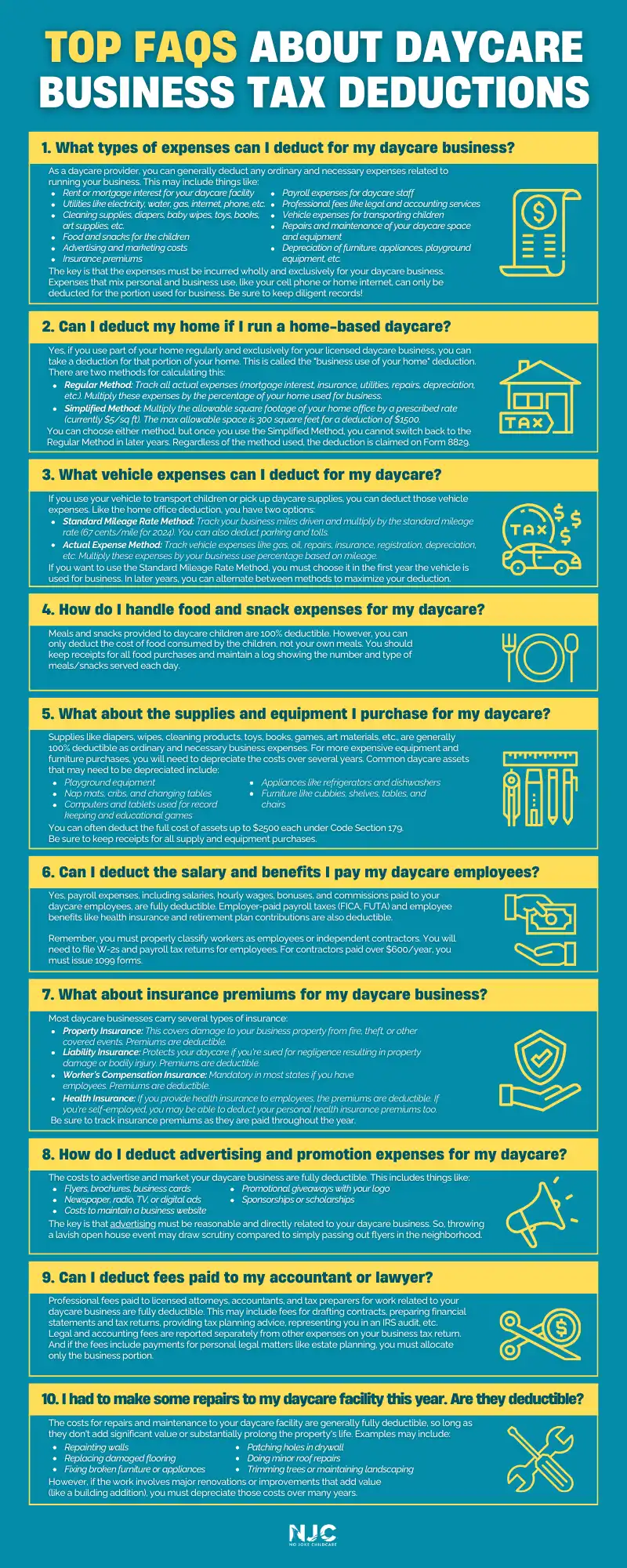
Top FAQS About Daycare Business Tax Deductions

Maximize your daycare’s profitability by mastering these top tax deductions – we’ve got the answers to your most pressing questions!

1. What types of expenses can I deduct for my daycare business?

As a daycare provider, you can generally deduct any ordinary and necessary expenses related to running your business. This may include things like:

  • Rent or mortgage interest for your daycare facility.
  • Utilities like electricity, water, gas, internet, phone, etc.
  • Cleaning supplies, diapers, baby wipes, toys, books, art supplies, etc.
  • Food and snacks for the children
  • Advertising and marketing costs
  • Insurance premiums
  • Payroll expenses for daycare staff
  • Professional fees like legal and accounting services
  • Vehicle expenses for transporting children
  • Repairs and maintenance of your daycare space and equipment
  • Depreciation of furniture, appliances, playground equipment, etc.

The key is that the expenses must be incurred wholly and exclusively for your daycare business. Expenses that mix personal and business use, like your cell phone or home internet, can only be deducted for the portion used for business. Be sure to keep diligent records!

2. Can I deduct my home if I run a home-based daycare?

taxes for daycare business

Yes, if you use part of your home regularly and exclusively for your licensed daycare business, you can take a deduction for that portion of your home. This is called the “business use of your home” deduction. There are two methods for calculating this:

  • Regular Method: Track all actual expenses (mortgage interest, insurance, utilities, repairs, depreciation, etc.). Multiply these expenses by the percentage of your home used for business.

  • Simplified Method: Multiply the allowable square footage of your home office by a prescribed rate (currently $5/sq ft). The max allowable space is 300 square feet for a deduction of $1500.

You can choose either method, but once you use the Simplified Method, you cannot switch back to the Regular Method in later years. Regardless of the method used, the deduction is claimed on form 8829.

3. What vehicle expenses can I deduct for my daycare?

If you use your vehicle to transport children or pick up daycare supplies, you can deduct those vehicle expenses. Like the home office deduction, you have two options:

  • Standard Mileage Rate Method: Track your business miles driven and multiply by the sstandard mileage rate (67 cents/mile for 2024). You can also deduct parking and tolls.

  • Actual Expense Method: Track vehicle expenses like gas, oil, repairs, insurance, registration, depreciation, etc. Multiply these expenses by your business use percentage based on mileage.

If you want to use the Standard Mileage Rate Method, you must choose it in the first year the vehicle is used for business. In later years, you can alternate between methods to maximize your deduction.

4. How do I handle food and snack expenses for my daycare?

tax deductions for daycare business

Meals and snacks provided to daycare children are 100% deductible. However, you can only deduct the cost of food consumed by the children, not your own meals. You should keep receipts for all food purchases and maintain a log showing the number and type of meals/snacks served each day.

5. What about the supplies and equipment I purchase for my daycare?

Supplies like diapers, wipes, cleaning products, toys, books, games, art materials, etc., are generally 100% deductible as ordinary and necessary business expenses. For more expensive equipment and furniture purchases, you will need to depreciate the costs over several years. Common daycare assets that may need to be depreciated include:

  • Playground equipment
  • Nap mats, cribs, and changing tables
  • Computers and tablets used for record keeping and educational games
  • Appliances like refrigerators and dishwashers
  • Furniture like cubbies, shelves, tables, and chairs

You can often deduct the full cost of assets up to $2500 each under Code Section 179. Be sure to keep receipts for all supply and equipment purchases.

6. Can I deduct the salary and benefits I pay my daycare employees?

Yes, payroll expenses, including salaries, hourly wages, bonuses, and commissions paid to your daycare employees, are fully deductible. Employer-paid payroll taxes (FICA, FUTA) and employee benefits like health insurance and retirement plan contributions are also deductible.

Remember, you must properly classify workers as employees or independent contractors. You will need to file W-2s and payroll tax returns for employees. For contractors paid over $600/year, you must issue 1099 forms.

7. What about insurance premiums for my daycare business?

Most daycare businesses carry several types of insurance:

  • Property Insurance: This covers damage to your business property from fire, theft, or other covered events. Premiums are deductible.

  • Liability Insurance: Protects your daycare if you’re sued for negligence resulting in property damage or bodily injury. Premiums are deductible.

  • Worker’s Compensation Insurance: Mandatory in most states if you have employees. Premiums are deductible.

  • Health Insurance: If you provide health insurance to employees, the premiums are deductible. If you’re self-employed, you may be able to deduct your personal health insurance premiums too.

Be sure to track insurance premiums as they are paid throughout the year.

8. How do I deduct advertising and promotion expenses for my daycare?

  • Flyers, brochures, business cards
  • Newspaper, radio, TV, or digital ads
  • Costs to maintain a business website
  • Promotional giveaways with your logo
  • Sponsorships or scholarships

The key is that advertising must be reasonable and directly related to your daycare business. So, throwing a lavish open house event may draw scrutiny compared to simply passing out flyers in the neighborhood.

9. Can I deduct fees paid to my accountant or lawyer?

Professional fees paid to licensed attorneys, accountants, and tax preparers for work related to your daycare business are fully deductible. This may include fees for drafting contracts, preparing financial statements and tax returns, providing tax planning advice, representing you in an IRS audit, etc.

Legal and accounting fees are reported separately from other expenses on your business tax return. And if the fees include payments for personal legal matters like estate planning, you must allocate only the business portion.

10. I had to make some repairs to my daycare facility this year. Are they deductible?

The costs for repairs and maintenance to your daycare facility are generally fully deductible, so long as they don’t add significant value or substantially prolong the property’s life. Examples may include:

  • Repainting walls
  • Replacing damaged flooring
  • Fixing broken furniture or appliances
  • Patching holes in drywall
  • Doing minor roof repairs
  • Trimming trees or maintaining landscaping

However, if the work involves major renovations or improvements that add value (like a building addition), you must depreciate those costs over many years.
Bottom Line

In short, daycare providers can take advantage of many valuable business deductions to reduce their taxable income each year. Tracking expenses, retaining proper documentation, and understanding what you can and cannot deduct from your daycare business will save you big on taxes.

Whether you’re a new provider just starting out or a seasoned owner looking to take your daycare to the next level, we have the resources and expertise to help. Let No Joke Childcare be your business partner for daycare success! Schedule a strategy call today!

Do you want
more traffic?

Stop wasting money and unlock the hidden potential of your advertising.

Are you using Google Ads

Try our new free ads grader?

Boost your childcare center's ROI with Michael Tasner, Founder of No Joke Childcare. With his extensive experience and expertise in childcare marketing, Michael Tasner offers innovative strategies tailored to the unique needs of your center. From web 3.0 marketing to social media strategies, he'll guide you to achieve maximum visibility and generate quality leads. Don't miss out on this opportunity to supercharge your marketing efforts and position your center for success.

About Michael Tasner

Hey, I'm Michael Tasner. I'm determined to make your childcare center grow. My only question is, will it be yours?

Categories
daycare business tax deductions
Published On: 06/13/20247.7 min readViews: 1221

Are you running a daycare business and looking to maximize your tax deductions? As a daycare provider, you have many expenses that may qualify as valid business deductions. At No Joke Childcare, we understand that navigating the complexity of daycare business taxes can be challenging. That’s why we’ve compiled this list of frequently asked questions to help you understand daycare business tax deductions and boost your bottom line.

5 Stats and Facts About Daycare Business Tax Deductions

Tax season can be a daunting time for any business owner, and daycare providers are no exception. Here are five eye-opening stats and facts to shed some light on tax deductions for daycare business:

  • The Power of Record Keeping: A whopping 40% of small businesses underestimate their tax deductions due to poor record-keeping. For daycare providers, meticulous records of expenses throughout the year are crucial to maximizing deductions come tax time.

  • Home-Based Daycare Advantage: Did you know that in-home daycare providers can deduct a portion of their home expenses like utilities and mortgage interest? The key is determining the percentage of space dedicated to business use. This can significantly reduce your taxable income.

  • Investing in Yourself Pays Off: Professional development expenses for daycare providers, like attending conferences or taking relevant courses, are fully tax-deductible. With an average cost of childcare conferences around $200-$400, this can be a significant tax benefit.

  • Mealtime Math: Meals served to children in daycare can be partially deducted. The IRS allows a deduction of the deduction of the federal reimbursement rate for meals served under the Child and Adult Care Food Program (CACFP). Check with your state for specific details and potential additional deductions.

  • Don’t Be Afraid to Ask for Help: Navigating tax deductions can be complex. Consulting a tax professional familiar with daycare businesses can ensure you’re claiming all the deductions you deserve. Hiring an accounting professional is said to boost confidence in tax filing. Only 48% of small business owners feel secure on their own, but that number jumps to a confident 69% when they have professional help.

A little planning and knowledge go a long way. With these five key facts in mind, you can approach tax season with confidence and ensure you’re keeping more of your hard-earned income.

Top FAQS About Daycare Business Tax Deductions

Maximize your daycare’s profitability by mastering these top tax deductions – we’ve got the answers to your most pressing questions!

1. What types of expenses can I deduct for my daycare business?

As a daycare provider, you can generally deduct any ordinary and necessary expenses related to running your business. This may include things like:

  • Rent or mortgage interest for your daycare facility.
  • Utilities like electricity, water, gas, internet, phone, etc.
  • Cleaning supplies, diapers, baby wipes, toys, books, art supplies, etc.
  • Food and snacks for the children
  • Advertising and marketing costs
  • Insurance premiums
  • Payroll expenses for daycare staff
  • Professional fees like legal and accounting services
  • Vehicle expenses for transporting children
  • Repairs and maintenance of your daycare space and equipment
  • Depreciation of furniture, appliances, playground equipment, etc.

The key is that the expenses must be incurred wholly and exclusively for your daycare business. Expenses that mix personal and business use, like your cell phone or home internet, can only be deducted for the portion used for business. Be sure to keep diligent records!

2. Can I deduct my home if I run a home-based daycare?

taxes for daycare business

Yes, if you use part of your home regularly and exclusively for your licensed daycare business, you can take a deduction for that portion of your home. This is called the “business use of your home” deduction. There are two methods for calculating this:

  • Regular Method: Track all actual expenses (mortgage interest, insurance, utilities, repairs, depreciation, etc.). Multiply these expenses by the percentage of your home used for business.

  • Simplified Method: Multiply the allowable square footage of your home office by a prescribed rate (currently $5/sq ft). The max allowable space is 300 square feet for a deduction of $1500.

You can choose either method, but once you use the Simplified Method, you cannot switch back to the Regular Method in later years. Regardless of the method used, the deduction is claimed on form 8829.

3. What vehicle expenses can I deduct for my daycare?

If you use your vehicle to transport children or pick up daycare supplies, you can deduct those vehicle expenses. Like the home office deduction, you have two options:

  • Standard Mileage Rate Method: Track your business miles driven and multiply by the sstandard mileage rate (67 cents/mile for 2024). You can also deduct parking and tolls.

  • Actual Expense Method: Track vehicle expenses like gas, oil, repairs, insurance, registration, depreciation, etc. Multiply these expenses by your business use percentage based on mileage.

If you want to use the Standard Mileage Rate Method, you must choose it in the first year the vehicle is used for business. In later years, you can alternate between methods to maximize your deduction.

4. How do I handle food and snack expenses for my daycare?

tax deductions for daycare business

Meals and snacks provided to daycare children are 100% deductible. However, you can only deduct the cost of food consumed by the children, not your own meals. You should keep receipts for all food purchases and maintain a log showing the number and type of meals/snacks served each day.

5. What about the supplies and equipment I purchase for my daycare?

Supplies like diapers, wipes, cleaning products, toys, books, games, art materials, etc., are generally 100% deductible as ordinary and necessary business expenses. For more expensive equipment and furniture purchases, you will need to depreciate the costs over several years. Common daycare assets that may need to be depreciated include:

  • Playground equipment
  • Nap mats, cribs, and changing tables
  • Computers and tablets used for record keeping and educational games
  • Appliances like refrigerators and dishwashers
  • Furniture like cubbies, shelves, tables, and chairs

You can often deduct the full cost of assets up to $2500 each under Code Section 179. Be sure to keep receipts for all supply and equipment purchases.

6. Can I deduct the salary and benefits I pay my daycare employees?

Yes, payroll expenses, including salaries, hourly wages, bonuses, and commissions paid to your daycare employees, are fully deductible. Employer-paid payroll taxes (FICA, FUTA) and employee benefits like health insurance and retirement plan contributions are also deductible.

Remember, you must properly classify workers as employees or independent contractors. You will need to file W-2s and payroll tax returns for employees. For contractors paid over $600/year, you must issue 1099 forms.

7. What about insurance premiums for my daycare business?

Most daycare businesses carry several types of insurance:

  • Property Insurance: This covers damage to your business property from fire, theft, or other covered events. Premiums are deductible.

  • Liability Insurance: Protects your daycare if you’re sued for negligence resulting in property damage or bodily injury. Premiums are deductible.

  • Worker’s Compensation Insurance: Mandatory in most states if you have employees. Premiums are deductible.

  • Health Insurance: If you provide health insurance to employees, the premiums are deductible. If you’re self-employed, you may be able to deduct your personal health insurance premiums too.

Be sure to track insurance premiums as they are paid throughout the year.

8. How do I deduct advertising and promotion expenses for my daycare?

  • Flyers, brochures, business cards
  • Newspaper, radio, TV, or digital ads
  • Costs to maintain a business website
  • Promotional giveaways with your logo
  • Sponsorships or scholarships

The key is that advertising must be reasonable and directly related to your daycare business. So, throwing a lavish open house event may draw scrutiny compared to simply passing out flyers in the neighborhood.

9. Can I deduct fees paid to my accountant or lawyer?

Professional fees paid to licensed attorneys, accountants, and tax preparers for work related to your daycare business are fully deductible. This may include fees for drafting contracts, preparing financial statements and tax returns, providing tax planning advice, representing you in an IRS audit, etc.

Legal and accounting fees are reported separately from other expenses on your business tax return. And if the fees include payments for personal legal matters like estate planning, you must allocate only the business portion.

10. I had to make some repairs to my daycare facility this year. Are they deductible?

The costs for repairs and maintenance to your daycare facility are generally fully deductible, so long as they don’t add significant value or substantially prolong the property’s life. Examples may include:

  • Repainting walls
  • Replacing damaged flooring
  • Fixing broken furniture or appliances
  • Patching holes in drywall
  • Doing minor roof repairs
  • Trimming trees or maintaining landscaping

However, if the work involves major renovations or improvements that add value (like a building addition), you must depreciate those costs over many years.

Bottom Line

In short, daycare providers can take advantage of many valuable business deductions to reduce their taxable income each year. Tracking expenses, retaining proper documentation, and understanding what you can and cannot deduct from your daycare business will save you big on taxes.

Whether you’re a new provider just starting out or a seasoned owner looking to take your daycare to the next level, we have the resources and expertise to help. Let No Joke Childcare be your business partner for daycare success! Schedule a strategy call today!

daycare business tax deductions
Published On: 06/13/20247.7 min readViews: 1221

Are you running a daycare business and looking to maximize your tax deductions? As a daycare provider, you have many expenses that may qualify as valid business deductions. At No Joke Childcare, we understand that navigating the complexity of daycare business taxes can be challenging. That’s why we’ve compiled this list of frequently asked questions to help you understand daycare business tax deductions and boost your bottom line.

5 Stats and Facts About Daycare Business Tax Deductions

Tax season can be a daunting time for any business owner, and daycare providers are no exception. Here are five eye-opening stats and facts to shed some light on tax deductions for daycare business:

  • The Power of Record Keeping: A whopping 40% of small businesses underestimate their tax deductions due to poor record-keeping. For daycare providers, meticulous records of expenses throughout the year are crucial to maximizing deductions come tax time.

  • Home-Based Daycare Advantage: Did you know that in-home daycare providers can deduct a portion of their home expenses like utilities and mortgage interest? The key is determining the percentage of space dedicated to business use. This can significantly reduce your taxable income.

  • Investing in Yourself Pays Off: Professional development expenses for daycare providers, like attending conferences or taking relevant courses, are fully tax-deductible. With an average cost of childcare conferences around $200-$400, this can be a significant tax benefit.

  • Mealtime Math: Meals served to children in daycare can be partially deducted. The IRS allows a deduction of the deduction of the federal reimbursement rate for meals served under the Child and Adult Care Food Program (CACFP). Check with your state for specific details and potential additional deductions.

  • Don’t Be Afraid to Ask for Help: Navigating tax deductions can be complex. Consulting a tax professional familiar with daycare businesses can ensure you’re claiming all the deductions you deserve. Hiring an accounting professional is said to boost confidence in tax filing. Only 48% of small business owners feel secure on their own, but that number jumps to a confident 69% when they have professional help.

A little planning and knowledge go a long way. With these five key facts in mind, you can approach tax season with confidence and ensure you’re keeping more of your hard-earned income.

Top FAQS About Daycare Business Tax Deductions

Maximize your daycare’s profitability by mastering these top tax deductions – we’ve got the answers to your most pressing questions!

1. What types of expenses can I deduct for my daycare business?

As a daycare provider, you can generally deduct any ordinary and necessary expenses related to running your business. This may include things like:

  • Rent or mortgage interest for your daycare facility.
  • Utilities like electricity, water, gas, internet, phone, etc.
  • Cleaning supplies, diapers, baby wipes, toys, books, art supplies, etc.
  • Food and snacks for the children
  • Advertising and marketing costs
  • Insurance premiums
  • Payroll expenses for daycare staff
  • Professional fees like legal and accounting services
  • Vehicle expenses for transporting children
  • Repairs and maintenance of your daycare space and equipment
  • Depreciation of furniture, appliances, playground equipment, etc.

The key is that the expenses must be incurred wholly and exclusively for your daycare business. Expenses that mix personal and business use, like your cell phone or home internet, can only be deducted for the portion used for business. Be sure to keep diligent records!

2. Can I deduct my home if I run a home-based daycare?

taxes for daycare business

Yes, if you use part of your home regularly and exclusively for your licensed daycare business, you can take a deduction for that portion of your home. This is called the “business use of your home” deduction. There are two methods for calculating this:

  • Regular Method: Track all actual expenses (mortgage interest, insurance, utilities, repairs, depreciation, etc.). Multiply these expenses by the percentage of your home used for business.

  • Simplified Method: Multiply the allowable square footage of your home office by a prescribed rate (currently $5/sq ft). The max allowable space is 300 square feet for a deduction of $1500.

You can choose either method, but once you use the Simplified Method, you cannot switch back to the Regular Method in later years. Regardless of the method used, the deduction is claimed on form 8829.

3. What vehicle expenses can I deduct for my daycare?

If you use your vehicle to transport children or pick up daycare supplies, you can deduct those vehicle expenses. Like the home office deduction, you have two options:

  • Standard Mileage Rate Method: Track your business miles driven and multiply by the sstandard mileage rate (67 cents/mile for 2024). You can also deduct parking and tolls.

  • Actual Expense Method: Track vehicle expenses like gas, oil, repairs, insurance, registration, depreciation, etc. Multiply these expenses by your business use percentage based on mileage.

If you want to use the Standard Mileage Rate Method, you must choose it in the first year the vehicle is used for business. In later years, you can alternate between methods to maximize your deduction.

4. How do I handle food and snack expenses for my daycare?

tax deductions for daycare business

Meals and snacks provided to daycare children are 100% deductible. However, you can only deduct the cost of food consumed by the children, not your own meals. You should keep receipts for all food purchases and maintain a log showing the number and type of meals/snacks served each day.

5. What about the supplies and equipment I purchase for my daycare?

Supplies like diapers, wipes, cleaning products, toys, books, games, art materials, etc., are generally 100% deductible as ordinary and necessary business expenses. For more expensive equipment and furniture purchases, you will need to depreciate the costs over several years. Common daycare assets that may need to be depreciated include:

  • Playground equipment
  • Nap mats, cribs, and changing tables
  • Computers and tablets used for record keeping and educational games
  • Appliances like refrigerators and dishwashers
  • Furniture like cubbies, shelves, tables, and chairs

You can often deduct the full cost of assets up to $2500 each under Code Section 179. Be sure to keep receipts for all supply and equipment purchases.

6. Can I deduct the salary and benefits I pay my daycare employees?

Yes, payroll expenses, including salaries, hourly wages, bonuses, and commissions paid to your daycare employees, are fully deductible. Employer-paid payroll taxes (FICA, FUTA) and employee benefits like health insurance and retirement plan contributions are also deductible.

Remember, you must properly classify workers as employees or independent contractors. You will need to file W-2s and payroll tax returns for employees. For contractors paid over $600/year, you must issue 1099 forms.

7. What about insurance premiums for my daycare business?

Most daycare businesses carry several types of insurance:

  • Property Insurance: This covers damage to your business property from fire, theft, or other covered events. Premiums are deductible.

  • Liability Insurance: Protects your daycare if you’re sued for negligence resulting in property damage or bodily injury. Premiums are deductible.

  • Worker’s Compensation Insurance: Mandatory in most states if you have employees. Premiums are deductible.

  • Health Insurance: If you provide health insurance to employees, the premiums are deductible. If you’re self-employed, you may be able to deduct your personal health insurance premiums too.

Be sure to track insurance premiums as they are paid throughout the year.

8. How do I deduct advertising and promotion expenses for my daycare?

  • Flyers, brochures, business cards
  • Newspaper, radio, TV, or digital ads
  • Costs to maintain a business website
  • Promotional giveaways with your logo
  • Sponsorships or scholarships

The key is that advertising must be reasonable and directly related to your daycare business. So, throwing a lavish open house event may draw scrutiny compared to simply passing out flyers in the neighborhood.

9. Can I deduct fees paid to my accountant or lawyer?

Professional fees paid to licensed attorneys, accountants, and tax preparers for work related to your daycare business are fully deductible. This may include fees for drafting contracts, preparing financial statements and tax returns, providing tax planning advice, representing you in an IRS audit, etc.

Legal and accounting fees are reported separately from other expenses on your business tax return. And if the fees include payments for personal legal matters like estate planning, you must allocate only the business portion.

10. I had to make some repairs to my daycare facility this year. Are they deductible?

The costs for repairs and maintenance to your daycare facility are generally fully deductible, so long as they don’t add significant value or substantially prolong the property’s life. Examples may include:

  • Repainting walls
  • Replacing damaged flooring
  • Fixing broken furniture or appliances
  • Patching holes in drywall
  • Doing minor roof repairs
  • Trimming trees or maintaining landscaping

However, if the work involves major renovations or improvements that add value (like a building addition), you must depreciate those costs over many years.

Bottom Line

In short, daycare providers can take advantage of many valuable business deductions to reduce their taxable income each year. Tracking expenses, retaining proper documentation, and understanding what you can and cannot deduct from your daycare business will save you big on taxes.

Whether you’re a new provider just starting out or a seasoned owner looking to take your daycare to the next level, we have the resources and expertise to help. Let No Joke Childcare be your business partner for daycare success! Schedule a strategy call today!